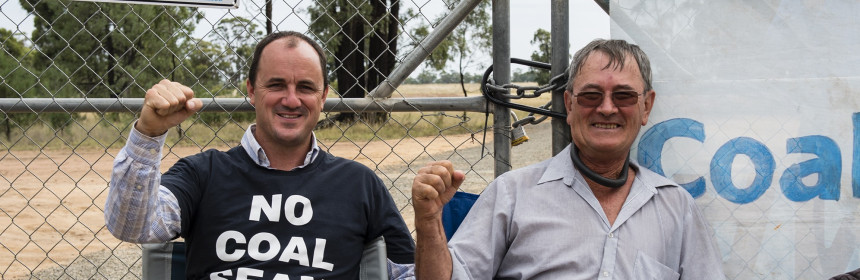
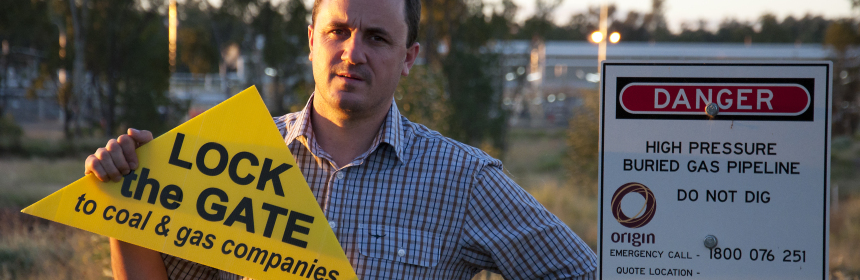
The NSW Greens today condemned Mike Baird, the National Party and the Shooters Party for ramming through laws that could see protestors, including farmers, jailed for up to 7 years for protecting land, water, climate and communities.
The laws were passed on a vote of 20-16 at 5.20pm this evening, with the Shooters and Fred Nile’s Christian Democrats voting with the Government . The laws increase fines for protestors by 1000%, give police additional powers to break up protests, search people and seize property, and expands the definition hindering a mine with a maximum penalty of seven years jail.
Greens MP and Mining Spokesperson Jeremy Buckingham said:
“This is Australia, not Vladimir Putin’s Russia. We should have the right to peaceful protest and political expression in this country.
“Land use conflict and opposition to fossil fuels is a major issue in NSW, but it needs a political solution, not a jack-boot police crackdown on democratic rights.
“The Liberals, Nationals and the Shooters Party have sided with the big mining and gas companies over farmers and the community. If farmers are thrown in jail for defending their land and water, the political parties that supported these laws will be punished by voters.
“Despite the Government’s threat, farmers and concerned citizens will continue to protest, no matter the penalty, because they are fighting for the common good,” Mr Buckingham said.
Greens MP and Justice Spokesperson David Shoebridge said:
“The right to protest dates back 800 years to the Magna Carta but Premier Baird is so arrogant that he believes he can trample that right to deliver for the Liberal party’s paymasters in the mining industry.
“Protest is an essential part of a functioning democracy, it ended slavery, delivered Aboriginal land rights, gave women the vote, saved the Franklin and protected the Rocks and that’s why the Greens will always support it.
“These laws have no social licence in NSW and if ever the police or the Liberal National parties try to enforce them, they will hit a wall of public protest that will stop them in their tracks,” Mr Shoebridge said.
“The Greens have a great candidate for the seat New England in Mercurius Goldstein. Mercurius and I have been working closely together on the campaign to protect land, water and communities from coal and coal seam gas.
“Tony Windsor is a titan of Australian politics and champion for the people of New England and the bush more widely. I wish him well in the election and I hope that Barnaby Joyce loses his seat because Barnaby has been absolutely hopeless in defending agriculture from coal mining and CSG.
“I will certainly be an attack dog going after Barnaby Joyce’s duplicity on issues such as the proposed Shenhua Watermark coal mine and coal seam gas. While the idea of running for New England and going head to head with Barnaby was attractive, I will not be a candidate for the seat of New England at this election.
“Coal mining and coal seam gas on key agricultural lands is a matter of national significance, as well as a key issue for the voters of New England. We should not be mining our food bowl, or threatening our precious water resources. The Greens are the only political party who acknowledge the reality that coal is in structural decline and we need a managed transition to clean energy and sustainable agriculture.
“I’m very happy in the NSW Legislative Council and in my role as Resources, Energy, Water and Agriculture spokesperson for the NSW Greens.
Mercurius Goldstein, Greens candidate for New England said:
“Local New England Greens members preselected and endorsed me as their candidate for New England in August of last year and the announcement was made at AgQuip 2015 in Gunnedah.
“New England voters will be attracted to the long term stable future the Greens offer in sustainable agriculture, protecting the Great Artesian Basin from coal and CSG, and securing Gonski funding for our rural schools.
“Among Greens in NSW, preselection decisions do not rest with a central party or MPs. It is a local New England members’ decision, and they endorsed me to stand for New England based on my performance in the NSW 2015 election.”
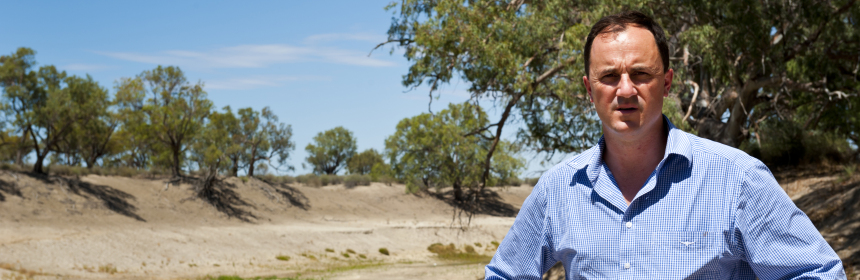
The Greens NSW Water Spokesperson Jeremy Buckingham today said he was shocked that state Water Minister, Niall Blair had not raised the issue of Broken Hill’s water crisis with the federal Water Minister Barnaby Joyce, and questioned whether the National Party was taking the issue seriously, or were simply looking out for their mates in the upstream irrigation industry.
“I asked Niall Blair a very simple question: had he made representations to Barnaby Joyce on the Broken Hill water crisis? Mr Blair spoke for a few minutes without answering the question – a clear indication he has not raised the issue with Mr Joyce,” said Greens MP Jeremy Buckingham.
“What the hell is Minister Niall Blair doing if he hasn’t even raised the issue of Broken Hill’s water supply with Barnaby Joyce in the six months since Barnaby took on the federal water portfolio?
“Both Mr Blair and Mr Joyce are members of the NSW Nationals. Surely they should have discussed it? What is the excuse? Are they forgetful or do they not care?
“Barnaby Joyce was based in St George in the heart of Queensland’s cotton irrigation belt, and was informally known as the “Member for Cubbie Station”. I fear that the National Party are looking after their mates in the cotton industry ahead of the people of Broken Hill and others reliant on the Darling River.
“There have been several rain events in Southern Queensland, but the Darling River is dry as a bone.
“We need a water minister who is prepared to stand up and fight for the people reliant on the Darling River, but Mr Blair is failing to even raise the issue with his National Party colleagues.
“The fact is the National Party has sold the people of the far West down the river, just as they sent all the water from the Menindee Lakes down river.”
Hansard Transcript of Question and Answer:
WESTERN NEW SOUTH WALES WATER
8 March 2016
Mr JEREMY BUCKINGHAM: My question is directed to the Minister for Lands and Water. Have formal representations been made on behalf of the people of Broken Hill, Menindee, Wilcannia and Pooncarrie to the Federal Minister for Water, Barnaby Joyce, regarding their water crisis? If so, what has been his response?
The Hon. NIALL BLAIR: I thank the member for his question. Each of those places is different and there are a number of different elements I could run through about a series of projects. Even though they originally come off the Darling system, some of them utilise weirs for their water supply, some have bores and some are looking at bigger projects. In some cases this Government has not needed to go to anyone else for assistance because it has been able to allocate funds. Regarding the short-term and long-term solution for Broken Hill, this Government has funded it through its promise it took to the 2015 election. It does not need to seek extra funding for that project to commence because the funds have been committed. Regarding some other projects, the Department of Primary Industries Water can fund those projects within the commitments that this Government has made.
We cannot talk about issues relating to water security for communities such as Broken Hill, which relies on the Menindee system, without talking to the Federal Government and other States. All those systems are intrinsically linked. The operation and the types of works that we are talking about in places such as Menindee, particularly when there is water in the lakes, falls to the Federal Government. The issue has been raised not only with the Federal Government but also with the Victorian and South Australian governments. Those are the types of things that we have regularly discussed at the ministerial council. More importantly, we have discussed what we are doing with communities up and down the Darling system. What is an issue at Menindee is also an issue for the communities that rely on the irrigation sector further upstream and downstream of Menindee.
Mr Jeremy Buckingham: Point of order: My point of order is relevance. My question asked what formal representations the Minister had made specifically to the Hon. Barnaby Joyce. We are nearly two minutes into his answer and he has not been generally relevant to the question about representations to the Minister.
The PRESIDENT: Order! There is no point of order.
The Hon. NIALL BLAIR: Those issues are regularly discussed with a number of stakeholders, including communities along the Darling system, other States that have involvement with the operating system and other jurisdictions such as the Federal Government. Those issues are discussed quite openly with the Federal Minister at the ministerial council. I have had discussions with the local member, Sussan Ley, about what is happening out there and also about redistribution. The township of Broken Hill and Menindee Lakes will be redistributed into another Federal seat. I am sure there will be another series of conversations with Federal members about what we are planning. The point is that the New South Wales Government is funding this project. It took that issue to the election. Those opposite stood in the way of that funding. This Government is now building on the short-term solutions we have already implemented to create long-term solutions. The operation of Menindee Lakes is regularly discussed with many different stakeholders. [Time expired.]
The Greens NSW mining spokesperson Jeremy Buckingham today questioned the coal industry’s grasp on reality after Kepco Australia vice president Bill Vatovec told the Sydney Mining Club that it was a golden age to build a mine and requested industry support to overcome community opposition.
“This is a golden gas to build a mine. The risk is in the money we have spent but the opportunity for us is that we wouldn’t get a better climate to build a mine than now.”
“I question Mr Vatovec’s grasp on reality in make this statement given the global glut of coal, plummeting prices, the number of existing coal mines closing or being put up for sale, and global policies to mitigate climate change,” said Greens MP Jeremy Buckingham.
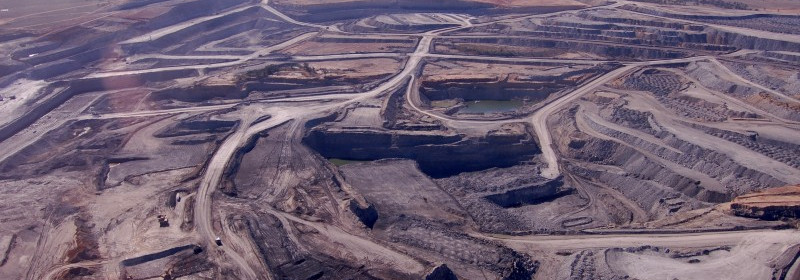
“Action on climate change is urgent, the age of coal is over and NSW does not need any new coal mines, particularly mines in the pristine Bylong Valley with its valuable agricultural land and water resources.
“This is a cry for help from a company that admits it does not have a social licence from the community and is pleading with the industry to leverage its links with politicians to get its mine approved.
“A social licence matters as we have seen with other resource projects such as Metgasco and AGL’s coal seam gas proposals and Shenhua’s proposed mine on the Liverpool Plains. Kepco cannot buy a social license from the government or its mining mates.”
“If Kepco really wants an Australian coal mine, it should look to purchase an existing mine from Rio Tinto or others. It is not the golden age for new coal mines, it is the end of coal.
“The Greens policy is for a ban on new coal mines and a strategy to transition away from fossil fuels to renewable energy that provides for regional economic development and employment.”
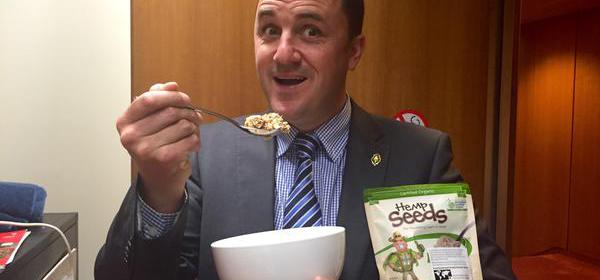
The Greens NSW health spokesperson Jeremy Buckingham today welcomed the support of the NSW Legislative Council after it voted 17-16 to adopt a motion calling on the Government to work with other Australian governments lift the ban on hemp food products. The Government opposed the motion but Fred Nile’s Christian Democrats and Labor voted with the Greens in favour.
“The ban on hemp food products in Australia is nonsensical, as Australians are missing out on a healthy and nutritious food source, and Australian farmers are missing out on profiting from a valuable crop and growing market,” said Greens MP Jeremy Buckingham.
“For years now Australia and New Zealand Ministerial Forum on Food Regulation has delayed making a decision on legalising hemp foods by commissioning endless reports and reviews. 2016 should be the year that a decision is finally made.
“I hope that Minister for Primary Industries, Niall Blair will get over this embarrassing loss and takes on the naysayers within the Government to get a win for farmers and consumers.
“Hemp foods have extremely low levels of THC and it is impossible to get stoned from them. Just about every other country in the world allows the consumption of hemp foods and Australian farmers are missing out on huge potential.
“Despite their supposed support for a hemp food industry, the Government opposed the motion. However, the motion was supported by the Greens, Labor and CDP MPs to be successful.
“The Shooters MPs, fresh after cynically adding “Farmers” to their party name, failed to turn up to this important debate about agriculture in NSW, and failed to vote on the motion. It’s a shocking start for these pretenders.”
Notice of Motion:
Mr Buckingham to move—
That this House notes that:
(a) the current ban on the sale of hemp food products is costing Australian farmers a slice of a billion dollar global industry,
(b) Australia and New Zealand are the only countries in the world where the sale of hemp food is illegal,
(c) approval for the sale of hemp food products is supported by Food Standards Australiaand New Zealand (FSANZ),
(d) the 2012 FSANZ report for approval states that:
(i) hemp has no psychoactive properties and, therefore, could not be detectable in drug tests,
(ii) there is no evidence of adverse health effects in humans at low levels of tetrahydrocannabinol exposure,
(iii) hemp grows in a distinctly different way to marijuana and would be easilydetectable by drug enforcement agencies,
(iv) no countries have reported any problem with mixed messaging regarding drug law enforcement, and
(e) the current ban on hemp food products is impeding the development of a sustainable hemp fibre industry.
That this House calls on the Government to:
(a) work proactively with the Federal and other State and Territory Governments to lift the ban on hemp food products in Australia, and
(b) assist farmers in the development of a sustainable hemp food and fibre industry.
The Greens NSW mining spokesperson Jeremy Buckingham today said the admission from a federal government source to the ABC that the Shenhua Watermark coal mine was “unlikely” to go ahead and the expiration of the exploration licence on Monday, provided the opportunity for the NSW Government to provide farmers on the Liverpool Plains with certainty by giving the Chinese mining company its money back and cancelling the licence forever.
“The admission that the Shenhua Watermark coal mine is “unlikely” to go ahead highlights the need for the Premier Mike Baird to act to end the shambles and provide certainty to farmers,” said Greens MP Jeremy Buckingham.
“The Shenhua Watermark coal mine makes no sense in the current commodities market and has virtually no support to go ahead. Premier Mike Baird should end the uncertainty, can the mine and negotiate the return of the $300 million the company paid the NSW Government for the exploration licence.
“The NSW Government should establish and reveal whether the Chinese Government moratorium on new coal mines applies to the Shenhua Watermark coal mine?
“Why should the fertile Liverpool Plains be damaged for a giant new coal mine when a decline in demand and the massive glut of coal on the world market has caused the suspension of new coal mines in China itself?
“Farmers need certainty to make investment decisions, so it is important that the threat of this mine does not hang over their heads for years to come.”
The Greens NSW mining and agriculture spokesperson Jeremy Buckingham today called on Premier Mike Baird and NSW Resources and Energy Minister Anthony Roberts to support a national framework to give landholders and traditional owners the legal right to say no to coal and gas companies coming onto their land.
Minister Roberts will be attending a meeting of COAG Mining and Energy Ministers on Friday (4 December) and the issue of a landholders’ right to say ‘no’ will be on the agenda after Federal Minister Josh Frydenberg confirmed in October that he would “bring the state ministers together to plan a way forward.”
“The public overwhelmingly support farmers and traditional owners having the right to protect their land and water from coal and gas companies and Friday’s COAG meeting is an opportunity to finally make this a reality,” Greens MP Jeremy Buckingham said.
“The time for talk is over. Mike Baird and Anthony Roberts need to go into the COAG meeting on Friday with a concrete proposal to give landholders and Traditional Owners the legal right to say no to coal and gas mining on their land.
“Landholders have had enough of politicians at a federal and state level narrow casting about the right to say no but then comprehensively failing to deliver on their promises.”
“Coal seam gas and coal exploration is highly disruptive to farming activities and risks polluting the land and water. It is time for the NSW Government to stop the political deception and support legislation to enshrine the right to say no.”
Senator Richard Di Natale, Australian Greens Leader, said COAG must act urgently to give landholders in every state and territory legal rights to say no to coal and gas mining on their land.
“We Greens have legislation in the federal and state Parliaments to give landholders the legal rights they deserve to protect their land, water and climate.
“The Nationals say one thing in regional communities and the media and then do the opposite in Parliament.
“Communities are sick of the empty promises and the Greens are standing with them to demand that COAG finally acts to fix this injustice,” Senator Di Natale said.
Contact (Jeremy Buckingham): Jack Gough – 9230 2202 or 0427 713 101
Contact (Richard Di Natale): Andrew Blyberg – 0457 901 600