Posted on 11 April 2013
Comments Off
Posted on 20 March 2013
The Greens NSW spokesperson on mining Jeremy Buckingham today condemned the National Party for rejecting a parliamentary call for papers on the Shenhua Watermark coal project in the Liverpool Plains. The Greens moved in formal business for all papers relating to the controversial mine licence granted by former Minister Ian Macdonald in 2008 to be provided to Parliament within 14 days, but Nationals MP Rick Colless objected to the call for papers.
“It’s very concerning that the National Party have stopped the parliament accessing documents related to the Shenhua Watermark coal project and the exploration licence granted by former Minister Ian Macdonald,” said Greens MP Jeremy Buckingham.
“Why is the National Party covering up information on a coal licence issued by former Labor Minister Ian Macdonald? Once again the National Party is failing country people by siding with the big mining companies.
“Shenhua paid the NSW government a record $300 million for the exploration licence, promised a further $200 million on approval, and has spent $213 million purchasing farm properties in the Liverpool Plains area. The development application for this mine is currently before the Department of Planning.
“Given the revelations coming out of current ICAC investigations and the controversy surrounding the Watermark project, it is only sensible that Parliament have a look into the matter by calling for all related documents.
“Barry O’Farrell and the National Party should explain why they want to hide information from the public about how Ian Macdonald handled the Shenhua Watermark project.
“The Greens will continue parliamentary moves to shed light on the Watermark project.”
Contact: Max Phillips – 9230 2202 or 0419 444 916
1144. Mr Buckingham move—
That, under standing order 52, there be laid upon the table of the House within 14 days of the date of passing of this resolution all documents relating to the Watermark coal project and related licences (including but not limited to EL7223 and Auth 216), excluding any document previously provided to the House under standing order 52, in the possession, custody or control of the Premier, the Department of Premier and Cabinet, the Minister for Planning, the Department of Planning and Infrastructure, the Minister for Resources and Energy, the Minister for Trade and Investment and Minister for Regional Infrastructure and Services, the Department of Trade and Investment, Regional Infrastructure and Services, and any document which records or refers to the production of documents as a result of this order of the House.
(Notice given 19 March 2013—expires Notice Paper No. 150)
Comments Off
Posted on 07 March 2013
Media Release
The Greens NSW spokesperson on mining Jeremy Buckingham today said the assessment of the Shenhua Watermark coal mine proposed for the highly productive Liverpool Plains area would be a make or break test of the O’Farrell Government’s Strategic Regional Land Use Policy, and if the mine is approved it would represent a policy failure. The Environmental Impact Statement for the proposed coal mine has been put on public exhibition until the Friday 26 April 2013.
“Everybody knows that the black soils of the Liverpool Plains and the underlying aquifers are far too precious to put at risk. It’s just commonsense that digging a huge open cut coal mine in the middle of a critical food and fibre producing area is a bad idea,” said Greens MP Jeremy Buckingham.
“Newly minted National Party MP Richard Torbay broke ranks with his National Party colleagues when he recently called for a ‘halt to mining and gas extraction on the Liverpool Plains’.
“Torbay’s comments have apparently infuriated other National Party MPs, including Leader, Andrew Stoner, the Member for Dubbo, Troy Grant, and Member for Barwon, Kevin Humphries.
“The government says that the Shenhua Watermark project will undergo “unprecedented scrutiny“, but the real question is whether the policy actually has the power to protect productive agricultural land by stopping a bad mine in the wrong area.
“The Strategic Regional Land Use Policy failed to rule out critical areas from mining or gas, instead implementing a gateway process in which the gate can not be shut. We will now see whether the policy has the teeth the government has promised.
“The Greens believe that food security and the long-term sustainable prosperity of the Liverpool Plains region should not be compromised for a Chinese state-owned coal mine leading to a few years of mine related development.
“Coal mining on the Liverpool Plains does not have a social licence. If the Strategic Regional Land Use Policy fails to reject this project, then I’m sure the community will step in to protect their land and water through locking their gates and implementing community blockades.”
Contact: Max Phillips – 9230 2202 or 0419 444 916
Comments Off
Posted on 07 March 2013
Comments Off
Posted on 07 March 2013
Comments Off
Posted on 07 March 2013
Comments Off
Posted on 16 November 2012
MEDIA RELEASE – 16 November 2012
Greens mining spokesperson Jeremy Buckingham will move a motion in the Legislative Council calling on the O’Farrell Government to suspend the Eddie Obeid related Mt Penny coal licence because of the evidence tendered in ICAC and the uncertainty the mine proposal is causing for Bylong Valley residents.

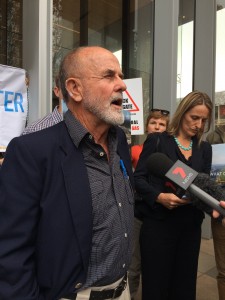
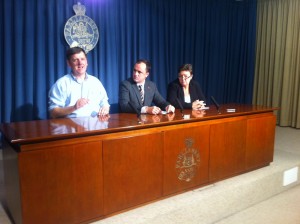
Craig Shaw and Jodie Nancarrow from the Bylong Valley Proection Alliance join Jeremy Buckingham at a press conference
“Given the evidence that has been presented to ICAC, I believe the Minister for Energy and Resources, Chris Hartcher, has cause to believe that false and misleading information is associated with the licence application and that the whole process itself may have been corrupted.
“Premier O’Farrell can not just allow the exploration licence to continue along with the planning application as if the government is oblivious to the major revelations made at ICAC. It’s time for Barry O’Farrell to give local residents some protection and certainty.”Residents of the beautiful Bylong Valley have been fighting this coal mine for years because they want to keep their valley as good farming country. The allegations involved in the ICAC inquiry only increase their uncertainty.
“The Greens have put on the Legislative Council notice paper a motion calling on the government to suspend or cancel this tainted exploration licence,” he said.
Contact: Max Phillips – 9230 2202 or 0419 444 916
a) to instruct the Energy and Resources Minister to investigate options for the suspension or termination of the exploration licences subject to the current ICAC inquiries and to release any legal advice obtained publically; and
b) if no legal avenues currently exist to suspend or terminate the licence to introduce legislation to the parliament to bring this into effect.
Comments Off
Posted on 09 November 2012
Responsible Mining (Protecting Land, Water and Communities) Bill 2012
Jeremy Buckingham, the NSW Greens spokesperson on Mining and Agriculture will introduce legislation to introduce clear no-go zones for mineral and gas exploration, mining and gas production.
The Greens Responsible Mining (Protecting Land, Water and Communities) Bill is a response to the demands of the NSW public to bring to an end the failed adaptive management and co-existence strategies of successive Governments that have seen mining and coal seam gas encroach on our agricultural lands, communities, and environment.
The challenge to secure agricultural land and water supplies to ensure we can continue to produce enough high quality food for the Australian and global population requires a clear segregation policy, a precautionary approach to extractive industries that prioritises the protection of food producing land and water.
The Responsible Mining Bill offers a clear alternative to the O’Farrell Government’s Strategic Regional Land Use Policy which ignores the Liberal and National Party’s own election commitment by failing to implement protections for those places where mining and other extractive industries simply should not occur.
The Responsible Mining (Protecting Land, Water and Communities) Bill 2012 will implement the following initiatives:
Rationale
NSW is currently suffering a death by a thousand cuts when it comes to mineral and gas exploration, mining and gas production. Many developments on their own may not have catastrophic impacts but the cumulative effect of project expansions, new green field developments and the layering of coal seam gas development next to coal mine has shown the ability if left unchecked for these industries to dominate landscapes, communities and the environment.
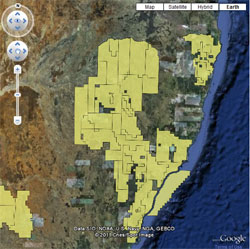
Today approximately 30% of the state is covered by petroleum exploration licences. Even more land is covered by mineral exploration and many applications for new exploration licences are currently before the Government.
The Government proudly projects a massive expansion in mining over the next decade and has proclaimed its intentions to develop a coal seam gas industry in this state.
The NSW community feels under siege by mining and gas exploration and development. At the moment in NSW there is not a single place a person can move to where they can be guaranteed not to be subject to mineral exploration or mining or gas development.
The Government and industry assertion that mining and other landuses can co-existence have proven false as the impact of producing coal seam gas in the United States and Queensland, where this industry is far more advanced, have become more widely known. In NSW the encroachment of coal mines on villages like Camberwell and the loss of agricultural land more widely in the Hunter Valley further weakens the co-existence argument. Putting in place a network of mining and gas no-go zones is the only way we can ensure our land, water and communities are protected.
What is responsible mining?
Mining and other extractive industries access finite, non-renewable resources. While we need many of these resources to support our communities and economy, the extraction and processing has a significant impact on other life dependent resources including food producing land, clean water, clean air, a safe and healthy environment in which to live, and a stable climate.
Responsible Mining is a model to manage these finite resources as demand for both mineral resources and other natural resources increases. A Responsible Mining approach looks to conserve mineral resources for the long-term benefit of the public while minimising the negative impacts and protecting those natural resources we rely on for survival like water, air and food producing land.
In 2005 a range of non-government organisations developed a discussion paper titled A Framework for Responsible Mining[i]. The lead chapter was titled: Deciding whether mining is an appropriate landuse. The arguments for the importance of no-go zones are clearly outlined in this paper and no-go zones are seen as a critical step to address the negative impacts of mining on communities.
While a complete framework for responsible mining would deal with issues as diverse as where mining could occur, managing health impacts, environmental protection, a fair local return from mining profits, creating local employment and training opportunities, respecting indigenous land tenure and sustainable mineral use and recycling, this legislation deals specifically with No-Go Zones as a way of addressing the immediate landuse conflict in NSW.
The Responsible Mining (Protecting Land, Water and Communities) Bill in detail
This bill sets out a range of no-go zones or areas that will now be off-limits to mining and gas exploration and production.
Currently mining and coal seam gas exploration and development is occurring close to and under residential communities. In Sydney, AGL’s Camden Gas project is slated for expansion into the Camden and Campbelltown local government areas, parts of Sydney Southwest growth corridor.
International, Queensland and local experience has demonstrated that subsidence, air quality and health impacts, well explosions and polluted waterways are likely impacts from mining and gas development.
These risks are completely unacceptable in and around urban areas whether residential or where people work in non-mining industrial and business areas.
Mining and extractive industries are already prohibited in National Parks in NSW but not in state conservation areas (SCA) and other reserve types. In fact the key difference between a National Park and these other areas is that mining is allowed.
Although there are around 800 parks and nature reserves managed by the Office of Environment and Heritage as part of its reserve System, only 199[ii] are national parks with the highest level of protection. These other areas are identified in the reserve system for their natural assets and often the presence of endangered ecological communities and threatened species.
If an area is gazetted as a reserve for environmental and recreational purposes whether a National Park or a Nature Reserve it should be protected from mining which is clearly an incompatible use when considered against the environmental and social objectives of these reserves.
The Government’s Strategic Regional Land Use Policy deals exclusively with what is termed ‘strategic’ agricultural land or the ‘best of the best’. The draft plans for the New England North West and Hunter show that massive areas of productive agricultural land is left out of the plans and would be subject to mining and coal seam gas proposals. Clearly the ‘best of the best’ definition means that many farmers in NSW who are growing important food for the Australian community would continue to be exposed to the risk of mining and gas development on their land.
Australia produces high quality food for local and international consumers but is increasingly constrained by water availability and loss of productive land because of urban and industrial encroachment. We simply can’t afford to lose more productive agricultural land to irresponsible development.
While it is generally accepted that National Parks and conservation areas should be protected from mining and extractive industries, there has been a slower realisation that there is a need to preserve our food growing areas. We need to protect productive agricultural land in ‘food reserves’.
The best definitions for productive land exist in the NSW Agriculture, Agricultural Land Classification publication.[iii] Protected land under the Responsible Mining Bill plans to included class 1, 2, and 3 land and specialist use land with a 5km buffer around those areas.
Travelling stock routes and state forests are natural resources that have been put aside for the specific purposes to support grazing and stock management and in the case of state forests, a viable native forest industry for wood products. Often these areas are also important reserves for endangered ecological communities.
To continue to diminish these natural assets by allowing exploration, mining and coal seam gas development will result in a long-term or possibly permanent loss of this land for those purposes.
The Responsible Mining Bill would ensure if land is identified as a travelling stock route or state forest that it be maintained for this purpose for the long-term benefit of future generations and not be opened up for mining or gas development.
Currently there is coal seam gas exploration and long wall mining occurring within Sydney’s drinking water catchment and there continues to be exploration licences in operation across many critical catchment areas. Pilot production for coal seam gas has recently been approved at Fullerton Cove near Newcastle close to the Tomago Sands Aquifer that is used to supplement drinking water supplies for the Newcastle community.
The protection of water quality for domestic use, stock and irrigation and the health of our river systems is not something that can be risk managed. An aquifer cannot be fixed and a river once polluted is almost impossible to clean.
In response to a question in parliament in 2011 the NSW Government acknowledged that historic antimony mining on the Dorrigo Plateau had deposited a plume of material containing heavy metals in the river system over a length of approximately 200 kilometres and that the plume would continue to release elevated levels of heavy metals for millennia[iv].
Clearly a precautionary approach is the only management technique available when it comes to protecting our water systems.The Responsible Mining Bill would not allow exploration, mining or gas production within 2km of river systems, productive aquifers and drinking water catchments.
A community right to say no
An important aspect of the Responsible Mining Bill is a provision to allow the community to make the ultimate decision about whether or not their village, town or region becomes a mining or gas precinct.
The failure of the mining and gas industries to demonstrate that they can co-exist with other industries means that without the assurance of a veto, local communities and the long-term sustainable industries that support them, particularly agriculture and tourism will continue to be sacrificed.
The Institute for Sustainable Futures in its 2009 Mineral Futures Discussion Paper noted that “a major discrepancy exists in the power of local communities to influence regional futures planning and decision-making relative to global corporations and governments”.[v]
This discrepancy has been illustrated numerous times as communities are encroached upon by mines approved originally as ’boutique’ operations which over time have expanded to the point of forcing out other industries and turning some towns into a little more than a mine service centre.
The Responsible Mining Bill would enable local councils to veto mining and gas activities through Local Environment Plans. The community can decide what mix of industries they want and where these industries can go.
It removes the right of a State or Federal Government to over-rule a council’s decision about where extractive industries can and cannot occur but retains the responsibility with the State Government to ensure development occurs with suitable environmental and planning conditions.
Next Steps
Jeremy Buckingham will spend the next three months touring NSW talking with mining affected communities, the mining industry, and local councils about the Responsible Mining Bill and taking on board community ideas to ensure the legislation can best deliver on community expectations.
It is expected the bill would come before Parliament for debate in the first half of 2013 but with enough community support The Greens would move to bring the bill on for urgent debate in the Legislative Council.
It is disappointing that after 18 months the O’Farrell Government seem no further down the track to protect land, water, health and communities from the impacts of mining and coal seam gas. The era of mining companies being given open access to NSW to profit from public resources at the expense of other industries, the environment, and community health needs to end.
The Greens Responsible Mining Bill offers a real way forward to achieving that.
Questions and Answers
Q. Does this bill allow coal and gas mining?
A. This legislation does not specifically prohibit coal and gas mining but would restrict all types of mining in protected areas to ensure land, water and communities are not scarified by irresponsible mining.
The Greens remain opposed to new coal and coal seam gas development and support a phase-out plan for existing operations.
Q. Can the State Government over-ride a community decision to veto mining or gas development in a certain area?
A. Under current legislation local councils do not have the ability to veto mining or gas development. The Responsible Mining Bill would create certain no-go zones but local council’s could then also exclude mining in other areas through their Local Environment Plan. The State and Federal Governments would not be able to over-rule these decisions.
Q. Won’t this legislation cost jobs by constraining the mining industry?
A. This bill will not stop any existing extractive industries so it will not cost current jobs. It will prohibit some projects already in the planning system so those future jobs will not be available. However by protecting land currently used for agriculture or supporting tourism or other industries, jobs in those long term and sustainable industries will be protected and grow as investment uncertainty for these industries is removed.
Q. If council’s are given veto rights won’t mining industries just try to take over councils?
A. The mining industry seems to have disproportionate influence over state and federal governments. The public feels excluded from these decisions because state and federal parliament seem so far away. By bringing these decisions back to local council the community can take responsibility for their own future and ensure they elect council representatives that reflect their hopes for that future.
The recent ban on corporate donations to political parties in NSW means that mining companies cannot fund the political campaigns of council candidates. This offers significant protection from the mining industry trying to gain disproportionate influence over future councils.
[iv] http://www.parliament.nsw.gov.au/prod/parlment/hansart.nsf/V3Key/LC20110908017?open&refNavID=HA8_1
[v] Institute for Sustainable Futures: Mineral Futures Discussion Paper: Sustainability issues, challenges and opportunities, 2009 : http://epress.lib.uts.edu.au/dspace/bitstream/handle/2100/926/giurcoetal2009mineralfuturesdiscussion.pdf?sequence=1
Comments Off
Posted on 25 October 2012
MEDIA RELEASE - 25 October 2012
The Greens NSW spokesperson on mining has condemned the approval of the Maules Creek coal mine by a Planning Assessment Commission today, saying the mine would be an act of environmental vandalism and represented a failure of the O’Farrell Government’s Strategic Regional Land Use Policy.
“This mine will destroy the Leard Forest, an area previously classified as Tier One biodiversity land in the draft Strategic Regional Land Use Plan for the North West,” said Greens MP Jeremy Buckingham.
“The Coalition promised before the election that they would protect ‘sensitive environments’ from mining, but here we have the last remnant woodland on the Liverpool Plains being destroyed for Nathan Tinkler’s open cut coal mine.
“Local farmers will be distraught at this decision and will question whether the National Party is there to represent the bush or the big mining companies and large coal barons?
“The PAC has somehow convinced itself that a 500 metre corridor of forest between the Maules Creek mine and Boggabri coal mine is adequate environmental safeguard, but the reality is a farce that suggests our planning system is broken.
“The Leard Forest was meant to enjoy a level of protection under the Brigalow and Nandewar Community Conservation Area Act 2005 for its ecological significance. Any mining in the area should be underground mining so as to preserve the forest as much as possible. By approving open cut mining, the PAC has undone the NSW Parliament’s intention.
“The 13 million tonnes of coal per year from this mine will contribute to dangerous climate change. NSW should be phasing out coal, not allowing Nathan Tinkler to destroy a forest,” he said.
Contact: Max Phillips – 9230 2202 or 0419 444 916
Comments Off
Posted on 09 October 2012
MEDIA RELEASE
9 October 2012
The Greens NSW spokesperson said today that Deputy Premier Andrew Stoner was not fit to lead the National Party and should resign after a dismal performance at Budget Estimates Committee hearings today where he did not know the number one agricultural commodity in NSW, had no knowledge of his government’s support for the biggest water buyback in Australian history and re-wrote the history of the Nationals’ position on mining and agriculture.
“It’s unbelievable that the leader of the National Party would not know what the number one agricultural commodity was in NSW, but Mr Stoner had to “take a stab in the dark”, guessing wheat,” said Greens MP Jeremy Buckingham.
When asked about the proposed Nimmie Caira water buy back on the Murrumbidgee River, the biggest in Australian history, the Leader of the Nationals admitted he did not know anything about it, despite it being supported by his government.
When asked about the Nationals election commitment that ‘agricultural land and other sensitive areas exist in NSW where mining and coal seam gas extraction should not occur’ Mr Stoner claimed the Nationals election commitment was for ‘coexistence’ of mining and agriculture.
Mr Stoner could not explain how government’s land use ‘gateway’ process functioned asserting that mining and gas development could be ‘stopped’, despite the policy explicitly stating that a gateway certificate or conditional gateway certificate must be issued.
Mr Stoner revealed that he had met with officials from Chinese coal giant Shenhua in China (Liverpool Plains coal mine proposal) and steel maker POSCO (Southern Highlands coal mine proposal) in South Korea. Mr Stoner also said landholders that were locking their gate “may be a case of cutting off their noses to spite their face”.
Jeremy Buckingham said: “Andrew Stoner is too busy meeting with foreign coal companies and dining out at high end restaurants to know what should be the bare basics for any leader of the National Party.
“Mr Stoner is clearly not up to the job and should make way for someone who actually knows and cares about country NSW,” he said.
Contact: Max Phillips – 9230 2202 or 0419 444 916
Comments Off